



Choosing a security camera is not simply about selecting the highest resolution or longest advertised range. The camera must capture the right area, work in the available lighting and provide enough detail to help you understand what happened when an incident occurs.
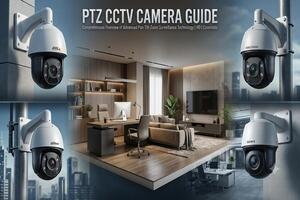
A PTZ CCTV camera is designed for situations where the viewing direction needs to change. It can turn towards different areas, tilt up or down and zoom in on a subject. This makes it useful for warehouses, parking facilities, factory premises, campuses and large residential compounds.
However, a PTZ camera is not always the most economical choice. A fixed camera may be better for a small entrance or shop counter, while a large property may benefit from combining PTZ cameras with fixed cameras.
This guide explains how PTZ cameras work, how to compare their range and night vision, which brands to consider, what prices to budget for and how to choose a setup suited to your property.
What Is the Full Form of PTZ CCTV Camera?
PTZ stands for Pan-Tilt-Zoom. These three functions allow the camera to change its viewing direction and magnification.
-
Pan: Moves the camera horizontally to look left or right.
-
Tilt: Moves the camera vertically to look up or down.
-
Zoom: Magnifies a subject so the operator can examine it more closely.
Consider a warehouse with a vehicle entrance, a loading bay and an open storage yard. An operator can direct a PTZ camera towards an incoming vehicle, zoom in on the loading area and then inspect activity in the yard. Supported models can also save preset positions or follow scheduled patrols.
The key advantage is flexibility: one camera can inspect several locations without an operator physically moving it. The limitation is that it cannot necessarily record every direction at once.
How Does a PTZ Camera Differ from a Fixed CCTV Camera?
The difference is not just movement; it is how the two camera types provide coverage. A fixed camera keeps monitoring its assigned view, while a PTZ camera can move to another area when needed.
| Consideration | Fixed CCTV camera | PTZ CCTV camera |
| Viewing direction | Stays on its installed view | Can pan and tilt |
| Zoom | Depends on the lens and model | Often includes optical zoom |
| Coverage style | Continuous monitoring of one view | Flexible monitoring of different views |
| Distant subjects | Depends on lens and resolution | Optical zoom can help examine distant subjects |
| Typical investment | Usually lower | Often higher |
| Best use | Entrances, counters, rooms and corridors | Large yards, parking areas and industrial premises |
Can one PTZ camera replace several fixed cameras? It can reduce the number needed in some layouts, but it is not a complete substitute when every area must remain visible continuously. If the camera turns towards the loading bay, activity at the gate may be missed.
For this reason, a useful design for a large property is often to place fixed cameras at critical entrances and use a PTZ camera for active monitoring of wider areas.
Which Type of PTZ CCTV Camera Should You Choose?
PTZ cameras differ in connectivity, construction and capabilities. The most suitable type depends on the equipment you already have and the conditions at the installation site.
Network IP PTZ cameras: These send video over an IP network and can work with compatible NVRs, monitoring software and authorised remote-viewing applications. Features such as intelligent detection, optical zoom and automatic tracking depend on the model.
Analog or HD PTZ cameras: These may suit existing CCTV systems that use compatible video transmission and control equipment. Confirm recorder compatibility before replacing an existing camera.
Compact PTZ cameras: Smaller models may be suitable for offices, entrances and certain residential locations. Their zoom, movement and night vision capabilities vary considerably.
Outdoor PTZ cameras: Designed for exposed environments, these may include weather-resistant housings, stronger mounting arrangements and operating specifications suited to outdoor use.
PTZ cameras with night vision: These use infrared illumination, low-light imaging or additional lighting to capture footage in darkness. The actual performance depends on the camera and the scene.
Before selecting a type, decide whether you need remote viewing, continuous recording, automatic tracking, integration with an existing recorder or operation in a poorly lit outdoor area. Those requirements narrow the options more effectively than choosing by appearance alone.
Which CCTV Camera Is Best for Outdoor Use?
The best outdoor CCTV camera depends on the area you need to protect, the distance to the subject and whether the camera must watch one location continuously or inspect several locations.
A PTZ CCTV camera is a strong option for large parking facilities, factory yards, warehouses and expansive compounds. A fixed bullet or turret camera is often more practical for a small gate, shopfront or narrow passage where the same view must be monitored throughout the day.
| Outdoor situation | Camera to consider | Reason |
| Home entrance or small gate | Fixed bullet or turret | Maintains a consistent view |
| Shopfront or narrow passage | Fixed outdoor camera | Focuses on one specific area |
| Large parking facility | Outdoor PTZ | Can inspect multiple sections |
| Factory or warehouse perimeter | Long-range PTZ with fixed cameras where needed | Supports distant monitoring and continuous critical-area coverage |
| Garden or residential compound | Fixed or PTZ | Depends on size, layout and viewing requirements |
| Poorly lit outdoor area | Suitable infrared or low-light camera | Improves visibility after dark |
For outdoor use, check the camera's IP rating, operating temperature range, mounting requirements and the protection of its cable connections. IP66 or IP67 may be appropriate for particular exposed installations, but the correct rating depends on the environment and the manufacturer's installation instructions.
Also consider glare from headlights, strong backlighting, rain, dust and obstructions such as trees. These can affect footage even when the camera itself is weather-resistant.
For a home, the best investment may be a well-positioned fixed camera rather than an expensive PTZ model. For a large commercial site, the flexibility of PTZ can be worthwhile when an operator needs to investigate activity across a wide area.
What Is the Range of a PTZ CCTV Camera?
The word range can mean three different things: the distance at which the camera can capture useful detail, the distance its infrared lighting can reach, or the angle through which it can move. These specifications should not be treated as interchangeable.
Viewing distance and image detail: A camera may detect movement at a distance without capturing enough detail to identify a person. When evaluating a product, distinguish between detecting an object, recognising what it is and identifying it clearly. Manufacturer DORI figures, where available, can help explain these different levels of detail, but real-world results depend on installation and scene conditions.
Pan and tilt range: Some models support continuous 360-degree horizontal rotation. Vertical movement varies by camera. A 360-degree pan specification means the camera can turn through a full circle, not that it records every direction simultaneously.
Infrared night vision distance: Infrared specifications describe the illumination range under stated conditions. A long advertised distance does not guarantee that a face or number plate will be identifiable at that distance.
Optical zoom: Optical zoom uses the lens to magnify the subject while retaining more image detail. Digital zoom enlarges the existing image and may reduce clarity.
When comparing cameras for a long boundary, parking area or industrial yard, ask the installer what level of detail can realistically be expected at the actual mounting distance. That is more useful than choosing a camera based on its maximum advertised range alone.
What Is the PTZ CCTV Camera Price in India by Brand?
The PTZ CCTV camera price depends on the brand, resolution, optical zoom, night vision, weather protection, tracking features and intended application. Entry-level models generally cost less than professional cameras designed for long-distance monitoring.
The following table gives indicative budgeting ranges, not guaranteed live prices for every model.
| Brand | Example category | Approximate camera price |
| CP Plus | Entry-level or compact PTZ | ₹9,000–₹22,000 |
| CP Plus | Professional 4MP PTZ with 32× optical zoom | ₹37,000–₹65,000 |
| Hikvision | Entry-level or compact PTZ | ₹12,000–₹28,000 |
| Hikvision | Professional PTZ with optical zoom | ₹33,000–₹66,000+ |
| Dahua | Entry-level or basic network PTZ | ₹17,000–₹32,000 |
| Dahua | Professional PTZ with optical zoom | ₹33,000–₹67,000+ |
These ranges are broad estimates for initial budgeting. Actual prices vary by model, seller, stock, warranty and included accessories. High-end or specialist models may cost considerably more.
For a more meaningful comparison, consider the specifications of an actual model rather than relying only on the brand:
-
CP Plus CP-UNP-E3241L18-DAQ: A 4MP network PTZ camera with 32× optical zoom, up to 180 metres of specified infrared illumination, and IP67 and IK10 protection.
-
Hikvision DS-2DF8225IX-AEL(W): A professional model with 25× optical zoom and continuous 360-degree pan.
-
Dahua DH-SD4A225DB-R-HNY: A 25× optical-zoom PTZ model with up to 50 metres of specified infrared illumination.
These examples illustrate how specifications differ; they are not a ranking of the three brands. Check the manufacturer's current documentation and local availability before choosing a model.
The camera-only price is also different from the complete installation cost. Your project may require a bracket or pole, cabling, a power supply or PoE equipment, a compatible recorder, storage, configuration and installation labour.
Ask for an itemised quotation and confirm the warranty, model number, accessories and service arrangements. This helps you compare the total cost rather than just the initial camera price.
How Should You Compare Hikvision, CP Plus and Dahua PTZ Cameras?
Hikvision, CP Plus and Dahua offer PTZ cameras for different budgets and surveillance requirements. There is no universally best brand: a suitable model must match the area, required detail, lighting and existing equipment.
Hikvision: Consider individual models for their optical zoom, low-light features, outdoor protection and available intelligent monitoring functions.
CP Plus: Compare the required resolution, zoom, infrared distance, recording compatibility and local service support. Its range includes professional models intended for demanding outdoor monitoring.
Dahua: Review the lens, optical zoom, night-time performance, weather rating and supported detection features for the exact model being considered.
Use this checklist when comparing two products:
-
Image quality: Does the resolution and lens provide sufficient detail at the actual viewing distance?
-
Zoom: Is the optical zoom suitable for the area you need to inspect?
-
Night performance: What illumination is available, and how much useful detail can the camera capture?
-
Weather protection: Is the model appropriate for the installation environment?
-
Compatibility: Will it work with your recorder, network and power equipment?
-
Support: Can you obtain a genuine product, warranty service and installation assistance?
-
Total cost: What is included in the final quotation?
A higher megapixel count or larger zoom number alone does not establish which camera will perform better in your property.
How Much Electricity Does a PTZ CCTV Camera Use?
Power consumption varies according to the camera's motors, infrared lights, heater, network connection and other features.
For example, a camera averaging 20 watts over continuous operation would consume:
-
Daily: 20 W × 24 hours = 0.48 kWh.
-
Monthly: Approximately 14.4 kWh over 30 days.
-
Estimated cost: ₹115.20 per month at ₹8 per unit.
This is an illustrative calculation, not a specification for every PTZ camera. Actual consumption may vary with operating conditions and accessories.
Check the manufacturer's rated power consumption and confirm that the power supply or PoE switch can support the camera's requirements, including peak demand when movement and illumination are active.
How Should You Install and Maintain an Outdoor PTZ Camera?
A PTZ camera needs a stable mounting point, suitable power, compatible recording equipment and a clear view of the areas it must monitor.
Before installation, mark the important locations on a simple site plan: entrances, parking sections, loading areas and boundary points. Identify obstructions and decide which locations require continuous recording. This helps determine whether a PTZ camera alone is sufficient or whether fixed cameras are also necessary.
Choose a mounting height and position that provide the required view while allowing the camera to move freely. Follow the manufacturer's instructions for weather protection, cabling, earthing and power requirements.
After installation, test the pan, tilt, zoom, night vision, recording playback and remote access. Check any presets or scheduled patrols and confirm that the footage provides useful detail at the intended distances.
During maintenance, inspect the lens, housing, mounting hardware and connections. Keep the lens clean and confirm that the camera continues to record correctly.
Can a Damaged PTZ CCTV Camera Be Repaired or Recycled?
A PTZ camera may be repairable if the problem involves its power supply, connection, motor, lens mechanism or other replaceable components. The appropriate repair depends on the fault. Disconnect a camera that appears electrically damaged or has suffered water ingress and have it inspected before using it again.
If the camera has reached the end of its useful life, send it to an authorised electronic-waste collection or recycling service. Remove any memory card if present and follow the manufacturer's guidance for resetting the device and removing stored credentials.
If you meant a PTZ camera that has developed rust, inspect its mounting hardware and housing for corrosion. Rust is not a standard camera feature; it is a possible maintenance issue that can affect structural strength or electrical connections in exposed environments.
How Do You Choose the Right PTZ CCTV Camera for Your Property?
Use the following decision guide before requesting a quotation.
| Your requirement | What to prioritise |
| Monitoring a small entrance | A suitable fixed camera may be sufficient |
| Viewing distant activity | Appropriate optical zoom and lens performance |
| Recording after dark | Suitable infrared or low-light performance |
| Monitoring a large outdoor area | PTZ movement, mounting stability and planned coverage |
| Keeping all entrances under continuous observation | Fixed cameras at critical points, with PTZ where useful |
| Upgrading an existing CCTV system | Recorder, cabling, control and power compatibility |
| Managing a limited budget | Total installation cost rather than camera price alone |
Before purchasing, establish the viewing distance, required image detail, lighting conditions, recording method and available budget. Ask the installer to explain any limitations and show how the proposed camera placement covers the important areas.
The right choice is not necessarily the most expensive camera. It is the model and installation arrangement that provide the coverage and image detail your property actually needs.
Final Thoughts on Buying a PTZ CCTV Camera
A PTZ CCTV camera is valuable when monitoring requires flexible viewing angles and the ability to inspect different areas from one mounting position. It is particularly useful for large outdoor premises where the operator needs to follow activity or examine distant subjects.
For smaller properties, a fixed camera may provide more reliable coverage at a lower cost. For larger sites, combining fixed cameras with a PTZ camera can balance continuous recording and flexible monitoring.
Compare model specifications, optical zoom, night vision, outdoor protection, power requirements, recorder compatibility and the full installation quotation before deciding. Good camera placement and realistic expectations about image detail are just as important as the product you buy.